Saturday, May 17, 2008

NASA Briefings and TV Coverage Schedule for Phoenix Mars Landing

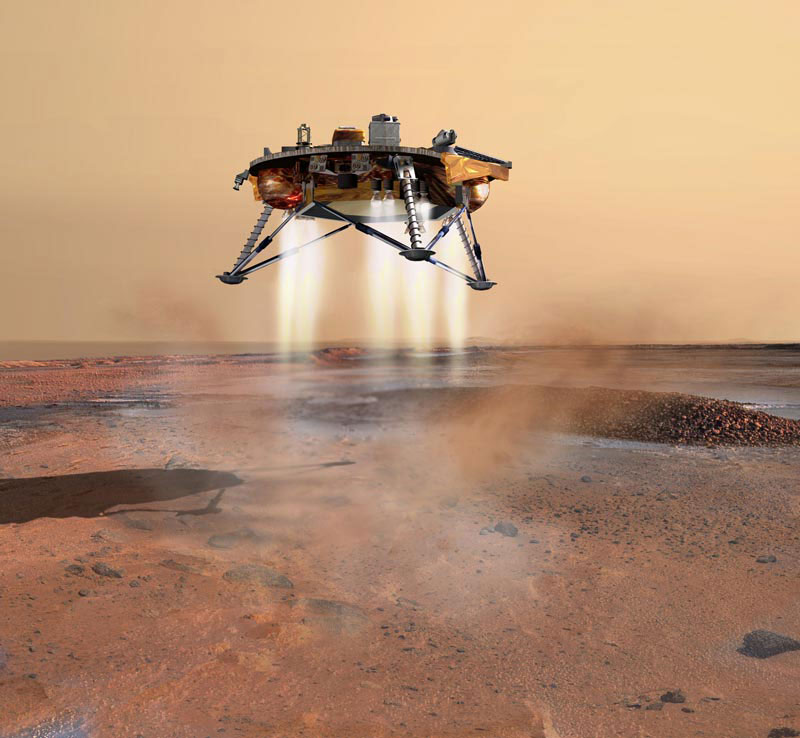
NASA news briefings, live commentary and updates before and after the scheduled Sunday, May 25 arrival of the agency's Phoenix Mars Lander will be available on NASA Television and on the Web.

In image: Artist concept of Phoenix landing on Mars.
Image credit: NASA/JPL-Caltech/University of Arizona

Entry, descent and landing begins at 4:46 p.m. PDT on May 25, when the flight team listens for radio signals indicating that Phoenix has entered the top of the Martian atmosphere. The spacecraft must perform a series of challenging
transformations and activities during the seven minutes after it enters the atmosphere to slow it from 12,000 mph to 5 mph and a soft touchdown. The Phoenix team will be watching for radio signals confirming the landing at 4:53 p.m. More than half of previous international attempts to land on Mars have been unsuccessful. For a detailed schedule and landing timeline, visit:

http://www.nasa.gov/phoenix

The deadline for U.S. journalists to request media credentials to cover the Phoenix mission from NASA's Jet Propulsion Laboratory in Pasadena, Calif., is Tuesday, May 20. Foreign journalists requesting credentials must apply by Friday, May 16. Requests for media credentials must be made online at:

https://eis.jpl.nasa.gov/media/index.html

Media wishing to cover the mission from the University of Arizona in Tucson, must apply online at:

http://uanews.org/marsmedia

Briefings on mission goals, challenges, status and final trajectory adjustments will originate from JPL on Thursday, May 22, at 11:30 a.m. and on Saturday and Sunday, May 25-26, at noon.

On landing day, May 25, live landing commentary will air on NASA TV. A telecast of mission control – without roll-in videos and interviews -- will run on NASA TV's Media Channel beginning at 3 p.m. Another telecast with commentary, interviews and videos will begin at 3:30 p.m. on NASA TV's Public Channel. For more information on NASA TV and this coverage schedule, visit:

http://www.nasa.gov/multimedia/nasatv/MM_NTV_Breaking.html

Both telecasts will continue through landing and will resume at 6:30 p.m. during the period after landing when engineers anticipate the receipt of data and possible images confirming that Phoenix has opened its solar panels successfully.

A news briefing at JPL will be held Sunday, May 25 at 9 p.m., following landing and the first possible downlink of images. Briefing updates at JPL also are scheduled on Monday, May 26 at 11 a.m. and on Tuesday, May 27 at 11 a.m.

Daily news briefings will continue at 11 a.m. for several days following a successful landing. Mission control and the site for news briefings will then shift to the University of Arizona in Tucson after a determination that the spacecraft is in a safe condition for conducting science operations. The earliest possibility for moving the host site for mission news briefings to the University of Arizona's Space Operations Center is Wednesday, May 28. Mission briefings from Pasadena and Tucson will be carried on NASA TV unless preempted by other NASA events.

For NASA TV streaming video, schedules, and downlink information, visit:

http://www.nasa.gov/ntv

From: http://mars.jpl.nasa.gov/

Thursday, May 15, 2008

World Wide Telescope

Twirling galaxies, exotic nebulae and exploding stars are now just a mouse click away for amateur astronomers.

Microsoft has launched WorldWide Telescope, a free tool that stitches together images from some of the best ground- and space-based telescopes.

The WorldWide Telescope (WWT) is a environment that enables your computer to function as a virtual telescope—bringing together imagery from the best ground and space-based telescopes in the world for a seamless exploration of the universe.

Choose from a growing number of guided tours of the sky by astronomers and educators from some of the most famous observatories and planetariums in the country. Feel free at any time to pause the tour, explore on your own (with multiple information sources for objects at your fingertips), and rejoin the tour where you left off. Join Harvard Astronomer Alyssa Goodman on a journey showing how dust in the Milky Way Galaxy condenses into stars and planets. Take a tour with University of Chicago Cosmologist Mike Gladders two billion years into the past to see a gravitational lens bending the light from galaxies allowing you to see billions more years into the past.

WorldWide Telescope is created with the Microsoft® high performance Visual Experience Engine™ and allows seamless panning and zooming around the night sky, planets, and image environments. View the sky from multiple wavelengths: See the x-ray view of the sky and zoom into bright radiation clouds, and then crossfade into the visible light view and discover the cloud remnants of a supernova explosion from a thousand years ago. Switch to the Hydrogen Alpha view to see the distribution and illumination of massive primordial hydrogen cloud structures lit up by the high energy radiation coming from nearby stars in the Milky Way. These are just two of many different ways to reveal the hidden structures in the universe with the WorldWide Telescope. Seamlessly pan and zoom from aerial views of the Moon and selected planets, as well as see their precise positions in the sky from any location on Earth and any time in the past or future with the Microsoft Visual Experience Engine.

WWT is a single that blends terabytes of images, information, and stories from multiple sources over the Internet into a seamless, immersive, rich media experience. Kids of all ages will feel empowered to explore and understand the universe with its simple and powerful user interface.

Microsoft Research is dedicating WorldWide Telescope to the memory of Jim Gray and is releasing WWT as a free resource to the astronomy and education communities with the hope that it will inspire and empower people to explore and understand the universe like never before.

How do you start exploring? Click the top of the Guided Tours tab and then click the Welcome thumbnail to watch a guided tour showing you how to navigate in WWT. Or click a link to read more: WWT in Depth
Site: World Wide Telescope

Tuesday, May 13, 2008

Winbond Accepts SiGlaz Intelligent Defect Analysis Software

IDA Enterprise Edition includes additional modules for large scale database management and real-time process monitoring

/HiTech PR News/ - SANTA CLARA, CA, March 28, 2008 - SiGlaz, a world leader in defect spatial signature analysis (SSA) software, today announced that its initial installation of Intelligent Defect Analysis (IDA) Enterprise Edition has been accepted by Winbond Electronics Corporation, a leading semiconductor manufacturer based in Taiwan. IDA software automatically analyzes the spatial distribution of defects on the wafer, using its patented algorithms, and notifies the user when it recognizes a signature. Defect spatial signatures may result from process excursions or from failures in process equipment.

IDA Enterprise Edition, which operates on a Microsoft Windows-based server with .NET framework and web service architecture, is compatible with all leading database software, including Microsoft SQL Server. It provides a fab-wide repository for signature analysis results and the ability to access those results in real time and from remote locations. A new IDA module, called Real Time Process Monitor, allows the user to run concurrent process control rules and generate alarms, refreshing the data hourly, daily or weekly. Another new module, called IDA Navigator, provides trend analysis capability and ad hoc queries of analysis results, and it allows the user to build, set and save process control rules and alarms.

"The Enterprise Edition of IDA provides a major benefit to our fab, in terms of analyzing large volumes of production defect data," according to a Winbond spokesperson. "Not only does IDA notify the engineer when it identifies a defect signature, the engineer can quickly access the IDA database from any location and view all of the data in the affected lots. In addition, IDA Auto-Learn capability and Layer Repeater Analysis enable us to identify new signatures that were not previously trained into the signature library."

SiGlaz IDA software automatically classifies defects associated with a spatial signature. When the performance of the software is compared to a human expert, the average performance of classification has been above 90%.

Victor Luu, SiGlaz President and CEO said, "We are very excited about our new software platform. IDA Enterprise Edition provides an upgrade path for our users to expand the utility and application of SSA in the fab. This new platform will be the foundation for other new SiGlaz products in the development pipeline that will soon allow users to correlate defect signatures with electrical test results, and then with other metrology data."

http://hitechprnews.com

Monday, May 12, 2008

Borland Reports First Quarter 2008 Financial Results and Announces Agreement for Sale of CodeGear Unit

Company Hits Transformation Milestone, Reaffirms 2008 Revenue and Profitability Expectations for Enterprise Segment

AUSTIN, Texas - May 07, 2008 : Borland Software Corporation (NASDAQ:BORL), the global leader in Open Application Lifecycle Management (ALM), today announced preliminary financial results for the first quarter ended March 31, 2008. Borland also announced today a definitive agreement to sell the assets of its individual developer tools unit, CodeGear, to Embarcadero Technologies. The purchase price for CodeGear is expected to be approximately $23 million. Borland will also retain CodeGear's accounts receivables with an approximate value of an additional $7 million. The transaction is expected to close by June 30, 2008.

For the first quarter of 2008, Borland reported total revenue of $58.3 million, GAAP net loss of $22.3 million, or $0.31 per share, and non-GAAP net loss of $4.0 million, or $0.05 per share. GAAP net loss included an impairment charge of $13.3 million in CodeGear goodwill, $1.6 million in stock-based compensation, $2.2 million in amortization of intangible assets, and $1.3 million in restructuring expenses.

Revenue for ALM products and services for the first quarter of 2008 was $32.4 million. Deployment (DPG) products and services revenue was $13.7 million and CodeGear (IDE) products and services revenue was $12.2 million.

"Borland is in the midst of a multi-year transformation aimed at creating a growing, profitable, innovative leader in the ALM market," said Tod Nielsen, president and CEO of Borland. "Today we achieved a significant milestone by signing an agreement to sell CodeGear. Upon deal closing, Borland will be able to accelerate cost reduction initiatives which will improve our strategic and operational performance."

Source of news

Wednesday, May 7, 2008

Cisco still cautious about U.S. economy

Network equipment maker Cisco Systems beat analyst expectations when it reported earnings Tuesday, but its lukewarm guidance showed that the slowing U.S. economy is still impacting the company.

Cisco, the world's largest supplier of equipment that shuttles traffic around the Internet, reported a net profit for the fiscal quarter of 2008 of $1.8 billion. This was down from profits of $1.9 billion in the same quarter a year ago, but it still beat analyst expectations.

Cisco graphic

Revenue for the quarter was up 10.4 percent to $9.8 billion. The company had forecast an increase in revenue of 10 percent.

Analysts believe that Cisco's results mean the company's business is stabilizing. But the sagging economy will still continue to impact its earnings for the next few quarters.

Last quarter, CEO John Chambers said the company was seeing a slowdown in technology spending in Europe and the U.S. And he predicted it would take two to five quarters for things to rebound.

On Tuesday's conference call, Chambers said that spending in the U.S. is still tight. And he anticipated that budgets will be constrained through at least the next two quarters. He said the company will likely see sales growth in the 9 percent to 10 percent range in the quarter that ends in July. But he maintained that the company's long term forecast of 12 percent to 17 percent revenue growth is still doable, indicating that he thinks the slump will be short-lived.

Sunday, May 4, 2008

nanoXplorer IDE - The Essential Software Resource for Nanotechnology Workgroups

nanoXplorer IDE - The Essential Software Resource for Nanotechnology Workgroups: "nanoXplorer IDE, available for download, is a software application for systems engineering of nanoscale devices--the essential software resource for nanotechnology engineers. It is the world's first software to make the nanodevice its central paradigm--empowering the nanoengineer to move to the vanguard of the nanotechnology revolution. If your team works with nanodevices, you need nanoXplorer IDE."


nanoXplorer IDE's research capabilities help you to stay current with the rapidly evolving multi-disciplinary field of nanotechnology. It contains introductory information for students or the non-technical and in depth information for professionals, educators and those pursuing advanced degrees. Getting the information you need is as simple as a single click on any of the dozens of nanotechnology-related topics available in the Research Perspective.

Designing nanoscale devices and other molecular systems is not an easy thing to do; nanoengineering is a truly multidisciplinary activity, requiring tools from chemistry, physics, computer-aided design, high-end visualization, mechanical engineering, and other areas. nanoXplorer IDE is unique in that it makes the nanodevice its central design paradigm and models more than just the chemistry. It provides an advanced 3D design space for constructing atomically precise nanoscale components. It offers workspaces where NanoFiles containing descriptions of nanocomponents can be quickly inspected. It provides wizards for the creation of common nanoscale molecules like nanotubes, buckyballs and DNA. In total, it offers an environment that supports your workgroup's requirements to work efficiently, accurately and collaboratively at the cutting edge of nanotechnology.

Desktop Linux strategies for marketplace success

By Carlton Hobbs on May 03, 2008 (2:00:00 PM)

What strategy is needed to really spread desktop Linux to average home users? Here are some ideas that just might work.

Journalist Steven J. Vaughan-Nichols argues that

Linux businesses, for the most part, don't do marketing. I think they're extremely foolish not to spend any money on it, but there it is.... Like the Linux companies, many of them were sure that they didn't need to market themselves. Like Linux companies, they thought word of mouth was enough.... Well guess what: it's not. Without marketing, no one from the outside looking in can tell one Linux from another. They just see a confusing mish-mash of names, and unless they're already really motivated, they're going to start turning off from Linux at the very start.

I argue almost the opposite. A large part of mainstream media marketing, advertising, and branding is a means to get name recognition at a very superficial level. Its main targets are people who make superficial buying decisions, and for the right products, this works. Why buy name brand Tylenol vs. generic acetaminophen, name brand cereal, or a thousand other identical products that come off the same assembly line but use different packaging at different prices? From the perspective of the thrifty, the main answers are ignorance and brand recognition.

Of course, not all marketing is to compete with effectively identical products. Consider the American beer industry as a major marketing powerhouse with a few similarities to the Windows vs. Linux market. The major American breweries formulated modern beers after Prohibition to appeal to people who didn't like the taste of beer, and as a side effect the major brewers accepted, these beers taste bad to beer connoisseurs. The post-Prohibition era, even to this day, retains elements of a cartelized liquor distribution industry designed to make it difficult and expensive to compete with the major breweries, such that there have been no new domestic majors in decades. The rebirth of real beer in America was through microbreweries that have small to non-existent marketing budgets. They rely on beer connoisseurs who communicate through beer fan reviews, word of mouth, willingness to experiment, and seeking out the minority of stores that actually carry microbrew and local beers. Beer commercials for microbrews about sports and sexy women would not get many beer drinkers to seek out good beer that isn't already easy to find. Such commercials are just for "all beer is beer" drinkers who are susceptible to brand association marketing and herd opinion.

This doesn't mean that high-cost marketing is innately wrong or bad. It means that if you can increase the marginal sales of your high-profit-per-sale product to people who make quick decisions based on brand recognition, then your marketing expenses were a good investment, but otherwise not. Unfortunately for Linux companies, desktop Linux is a very low profit per "sale" product that is not an impulse choice off a shelf of interchangeable consumer goods. As Red Hat learned years ago, the shrink-wrapped box on a store shelf will not change the current OS market.

So if word of mouth and near-zero-budget advertising are our main prospects, then perhaps what is needed is a better person-to-person strategy. Fortunately, there is definite room for improvement here. One major barrier to entry is lack of Linux preinstallation, and the occasional need for more expertise with compatibility issues. Desktop Linux must partly resolve these challenges through its internal advantage of strong community by strategic and expansionary networking, and by using the big opportunity of failure to address the massive number of PCs that people keep collecting dust, thinking they will upgrade sometime, someday.

Desktop Linux must focus on local communities for recruiting the next wave of users and evangelists. Ubuntu has the right idea with its LoCo initiative. However, to get really local and networked, a distro-centric local community is not the most efficient. If local Ubuntu, Debian, Slackware, etc. users never meet, they will forfeit great networking opportunities. There needs to be local GNU/Linux/FOSS communities with broad ranges of software experience, occupations, contacts, and distro preferences. Fortunately, many already exist, and there is at least one list where people can find groups near them. Linux promoters must recognize face-to-face personal interaction as a primary means for strategic growth of desktop Linux.

Local free software organizations need to be able to offer free Linux installation and encourage people to reuse or donate computers that would run poorly with current Windows systems. Certain groups are naturally good targets to recruit and possibly join as recruiters themselves. Decentralist political groups, neighborhood associations, Parent Teacher Associations, and other educational organizations are also intelligent low budget groups. College groups, homeschool groups, agriculture co-ops, churches, and religious groups are all great places to find people who have spare computers to reinvigorate or donate, or would be willing to have a computer set to dual boot. In general, groups that depend on donations or have small budgets are looking for ways to minimize unnecessary costs. Some of their members would likely be radicalized when they learn what little is required to show others how to switch to Linux.

Local free software organizations need a quick and easy tool to communicate what the GNU/Linux OS can do. Perhaps the best method would also serve as a means of introduction. An organization could create business cards that provide a brief description of the local Linux group, its Web address, and purpose. The card should be visually impressive and colorful. They can let people know that the card itself was designed with only free software, whether it be OpenOffice.org, gLabels, Inkscape, Scribus, or some combination that anyone could easily get through Linux.

Is there a model for such success without advertising budgets? Ask yourself how you heard about and started using Google. Was it through advertising? Google became a giant because the barrier to trying a new search engine was so low and the value quickly obvious. It was used by almost everyone before anyone saw a Google advertisement. If Linux advocates can do the same, then Windows will be in trouble. I don't see how this can happen without active local free software groups that seek out growth, and success would likely be in proportion to the efficiency of local groups. If some are more successful than others, then the more successful local methods could be adopted elsewhere.

All the experience and networked knowledge of local free software cooperatives might be enough that small businesses would hire the local groups to upgrade their computer systems to Linux for real money. Local groups could even have contracts with particular distros that provide paid business support to receive some of the profit. Local cooperatives would not likely make much money, but maybe enough on occasion to purchase a few rounds of quality microbrews to celebrate a few more people unshackled from Goliath-soft. Very few people will get rich with Linux, but a lot of people could be meaningfully less poor with it, and free-as-in-freedom might actually buy the enjoyment of a few free-as-in-beers.