Showing posts with label mars. Show all posts

Saturday, December 20, 2008

Mineral points to Martian water suitable for life

SAN FRANCISCO (Reuters) - Mineral evidence for a water environment capable of supporting life has been discovered on Mars, scientists said Thursday.

Deposits of carbonate, formed in neutral or alkaline water, were spotted by NASA's Mars Reconnaissance Orbiter, the scientists told a meeting of the American Geophysical Union in San Francisco.

"Obviously this is very exciting," said John Mustard of Brown University in Rhode Island. "It's white -- it's a bulbous, crusty material."

Carbonate is formed when water and carbon dioxide mix with calcium, iron or magnesium. It dissolves quickly in acid, so its discovery counters the theory that all water on Mars was at one time acidic.

"It would have been a pretty clement, benign environment for early Martian life," said Bethany Ehlmann, a graduate student at Brown University who led the study published in the journal Science.

"It preserves a record of a particular type of habitat, a neutral to alkaline water environment."

Carbonates on Earth like chalk or limestone sometimes preserve organic material, but scientists have found no such evidence on Mars.

The 3.6 billion-year-old carbonate was discovered in bedrock at the edge of a 930-mile-wide (1,490-km-wide) crater.

Carbonate previously had been found in minuscule amounts in soil samples provided by the Phoenix Mars Lander, Martian dust and Martian meteorites on Earth. But this is the first time scientists have found a site where carbonate formed.

The deposits are about the size of football fields and are visible in images taken by the Mars Reconnaissance Orbiter.

The deposits appear to be limited, but the neutral or alkaline water environment may once have been more widespread, said Scott Murchie, a scientist at Johns Hopkins University in Baltimore.

Phyllosilicates, which form under similar conditions to carbonate but do not dissolve in acidic environments, are abundant on Mars.

"There were these different water environments in early Mars history, (which) increases the possibilities that life started," said Richard Zurek of NASA's Jet Propulsion Laboratory in California.

(Editing by Maggie Fox and Xavier Briand)

By Clare Baldwin: Reuters.

Saturday, May 17, 2008

NASA Briefings and TV Coverage Schedule for Phoenix Mars Landing

NASA news briefings, live commentary and updates before and after the scheduled Sunday, May 25 arrival of the agency's Phoenix Mars Lander will be available on NASA Television and on the Web.

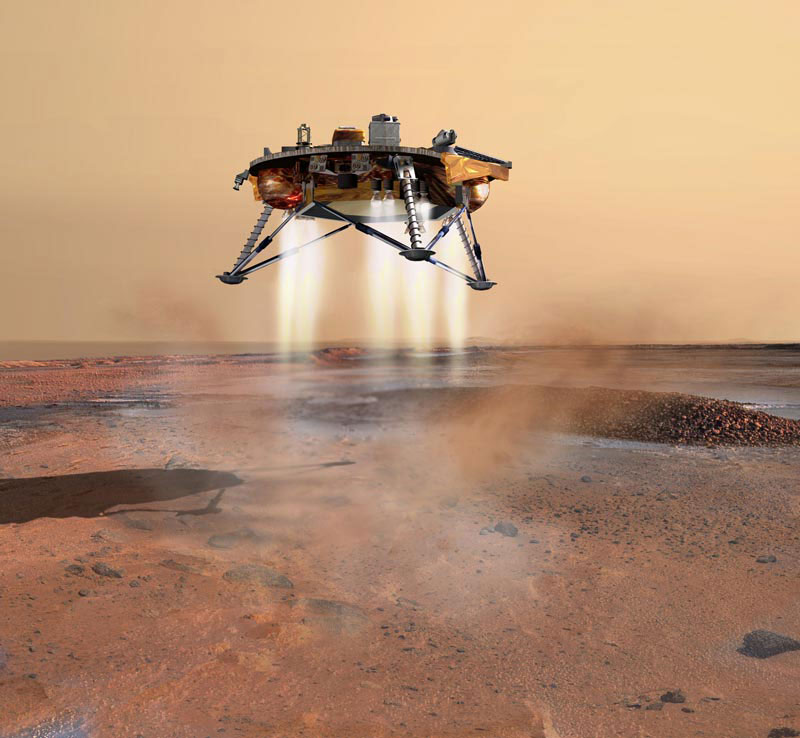
In image: Artist concept of Phoenix landing on Mars.
Image credit: NASA/JPL-Caltech/University of Arizona

Entry, descent and landing begins at 4:46 p.m. PDT on May 25, when the flight team listens for radio signals indicating that Phoenix has entered the top of the Martian atmosphere. The spacecraft must perform a series of challenging
transformations and activities during the seven minutes after it enters the atmosphere to slow it from 12,000 mph to 5 mph and a soft touchdown. The Phoenix team will be watching for radio signals confirming the landing at 4:53 p.m. More than half of previous international attempts to land on Mars have been unsuccessful. For a detailed schedule and landing timeline, visit:

http://www.nasa.gov/phoenix

The deadline for U.S. journalists to request media credentials to cover the Phoenix mission from NASA's Jet Propulsion Laboratory in Pasadena, Calif., is Tuesday, May 20. Foreign journalists requesting credentials must apply by Friday, May 16. Requests for media credentials must be made online at:

https://eis.jpl.nasa.gov/media/index.html

Media wishing to cover the mission from the University of Arizona in Tucson, must apply online at:

http://uanews.org/marsmedia

Briefings on mission goals, challenges, status and final trajectory adjustments will originate from JPL on Thursday, May 22, at 11:30 a.m. and on Saturday and Sunday, May 25-26, at noon.

On landing day, May 25, live landing commentary will air on NASA TV. A telecast of mission control – without roll-in videos and interviews -- will run on NASA TV's Media Channel beginning at 3 p.m. Another telecast with commentary, interviews and videos will begin at 3:30 p.m. on NASA TV's Public Channel. For more information on NASA TV and this coverage schedule, visit:

http://www.nasa.gov/multimedia/nasatv/MM_NTV_Breaking.html

Both telecasts will continue through landing and will resume at 6:30 p.m. during the period after landing when engineers anticipate the receipt of data and possible images confirming that Phoenix has opened its solar panels successfully.

A news briefing at JPL will be held Sunday, May 25 at 9 p.m., following landing and the first possible downlink of images. Briefing updates at JPL also are scheduled on Monday, May 26 at 11 a.m. and on Tuesday, May 27 at 11 a.m.

Daily news briefings will continue at 11 a.m. for several days following a successful landing. Mission control and the site for news briefings will then shift to the University of Arizona in Tucson after a determination that the spacecraft is in a safe condition for conducting science operations. The earliest possibility for moving the host site for mission news briefings to the University of Arizona's Space Operations Center is Wednesday, May 28. Mission briefings from Pasadena and Tucson will be carried on NASA TV unless preempted by other NASA events.

For NASA TV streaming video, schedules, and downlink information, visit:

http://www.nasa.gov/ntv

From: http://mars.jpl.nasa.gov/